Complete Guide to California's Self-Determination Program (SDP)
What If You Could Design Your Child's Services Yourself?
If you have a child with a developmental disability in California, you probably know the Regional Center system. You know the service coordinators, the vendored providers, the pre-approved lists. And if you're honest, you've probably felt frustrated at times by how rigid the system can be.
What if there were a way to take the funding your child is already entitled to and spend it on the services, providers, and supports that actually work for your family? That is exactly what California's Self-Determination Program is designed to do.
The Self-Determination Program, known as SDP, is a real alternative to the traditional Regional Center service model. It puts you in the driver's seat. You get an individual budget, you choose your own providers, and you decide how services are delivered. It's not a theory or a pilot anymore. SDP is an established program available statewide, and thousands of California families are already using it.
If you've been searching for "self determination program California" or wondering how self-directed services work for a disabled child, this guide will walk you through everything you need to know.
What Is the Self-Determination Program?
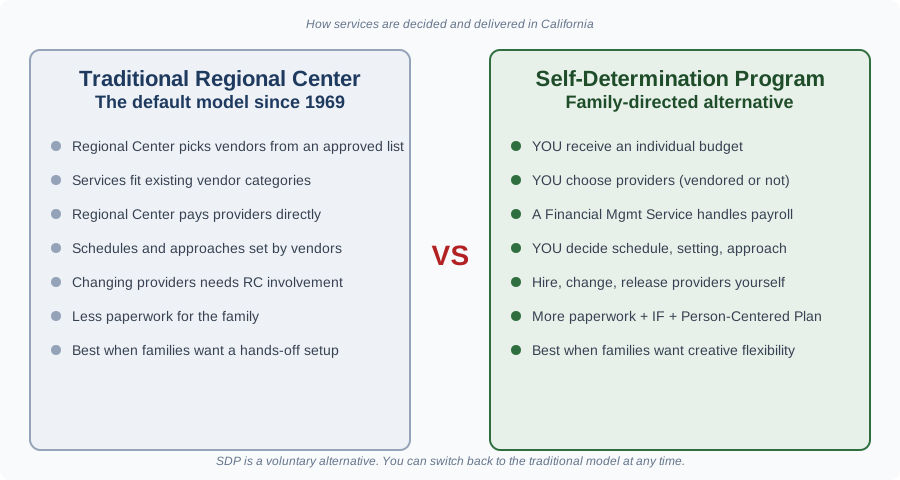
The Self-Determination Program is a voluntary alternative to the way Regional Center services are traditionally delivered in California. Under the standard model, your Regional Center assigns vendors to provide services like respite, day programs, behavioral therapy, or supported living. You choose from an approved list, and the Regional Center pays providers directly.
Under SDP, the process works differently:
- You receive an individual budget based on the services in your child's current Individual Program Plan (IPP).
- You choose your own providers, including people who are not vendored through the Regional Center.
- You decide how services are structured, including schedules, settings, and approaches.
- A Financial Management Service (FMS) handles the money, payroll, and compliance so you don't have to become an accountant.
The core philosophy is straightforward: families know their children best. When you give families genuine decision-making power over their services and budget, outcomes improve. Children and adults with disabilities get supports that actually fit their lives instead of fitting into a one-size-fits-all system.
How SDP Differs from Traditional Regional Center Services
Understanding the difference between SDP and traditional services is essential before you decide if it's right for your family.
Traditional Regional Center Model
- Regional Center selects vendored providers from an approved list
- Services must fit within existing vendor categories
- Regional Center pays providers directly
- Less flexibility in how, when, and where services happen
- Changing providers often requires Regional Center involvement
Self-Determination Program
- You select your own providers, including non-vendored individuals
- Services can be creative and individualized
- Your FMS pays providers based on your direction
- Greater flexibility in scheduling, location, and approach
- You can hire, change, or let go of providers on your own
Here's a real-world example. Under traditional services, your child might receive respite care from a vendored agency that sends whoever is available on a given day. Under SDP, you could hire a trusted neighbor, a college student studying special education, or a family friend who already has a wonderful relationship with your child, and pay them with your SDP budget through your FMS.
Who Is Eligible for the Self-Determination Program?
To participate in SDP, your child (or adult family member) must meet one fundamental requirement: they must be an active client of a California Regional Center.
This means they have been found eligible for Regional Center services due to a qualifying developmental disability such as:
- Autism spectrum disorder
- Intellectual disability
- Cerebral palsy
- Epilepsy
- Other conditions closely related to intellectual disability that require similar services
If your child is already receiving Regional Center services, they are likely eligible to transition to SDP. If your child is a Regional Center client but not currently receiving many services, they can still participate. The individual budget will be calculated based on their assessed needs.
There are no income requirements for SDP itself. Because SDP uses Regional Center funding (which is an entitlement, not means-tested), your family's income does not determine eligibility. This is different from programs like IHSS or Medi-Cal that have income thresholds.
SDP is available to Regional Center clients of all ages, from young children to adults.
Understanding Your Individual Budget
One of the most important concepts in SDP is the individual budget. This is the annual dollar amount you have available to purchase services for your child.
Your individual budget is calculated based on:
- The cost of services currently in your child's Individual Program Plan (IPP)
- Services that have been identified as needed but are not yet being provided
- The Regional Center's historical cost data for similar services
The budget is not pulled from thin air. It is directly tied to your child's assessed service needs. If your child currently receives respite, behavioral services, and a day program, those costs become the foundation of your individual budget.
An important point: SDP is about flexibility, not about automatically getting more money. Your starting budget is built from what the Regional Center was spending (or would spend) on your child's services. However, the budget is not strictly frozen at that amount. The IPP team can adjust it up or down if your child's needs, circumstances, or resources change, or if it identifies needs that were not being met under the traditional plan. You generally get roughly the same funding, but with dramatically more control over how it's spent.
If you disagree with your calculated budget, you have the right to appeal. Your independent facilitator (more on this role below) can help you navigate this process.
Financial Management Services (FMS) Explained
When families first hear about SDP, a common worry is: "I don't want to manage payroll and taxes and invoices." That's where Financial Management Services come in.
An FMS is a required part of SDP participation. Think of your FMS as your financial partner. They handle:
- Payroll processing for any workers you hire directly
- Tax withholding and reporting (W-2s, 1099s, employment taxes)
- Invoice payments to providers and vendors you select
- Budget tracking so you always know how much you've spent and what remains
- Compliance with state and federal employment and tax regulations
- Workers' compensation insurance for employees you hire
You tell the FMS who to pay, how much, and when. They execute the financial transactions and keep everything compliant. You stay focused on your child's care and services.
The cost of your FMS is paid from your individual budget, so factor this into your planning. Your Regional Center can provide a list of approved FMS providers in your area.
How to Apply and Get Started with SDP
Step 1: Express Interest to Your Regional Center
Contact your Regional Center service coordinator and tell them you are interested in SDP. Ask to be placed on the SDP interest list. Your Regional Center will provide you with information about the program and the enrollment process.
Step 2: Attend an Orientation
Most Regional Centers offer SDP orientation sessions. These may be in person, virtual, or self-paced. Orientations explain how SDP works, what your responsibilities will be, and what to expect. Attending an orientation is typically required before you can enroll.
Step 3: Select an Independent Facilitator
An independent facilitator is a person who helps you navigate SDP. They assist with person-centered planning, help you develop your spending plan, and advocate on your behalf. You choose your own facilitator. Your Regional Center can provide a list of available facilitators, or you may find one through other SDP families.
Step 4: Complete Person-Centered Planning
Working with your independent facilitator, you'll go through a person-centered planning process. This means sitting down and thoughtfully identifying what your child needs, what your family's priorities are, what a good life looks like for your child, and what services and supports will help get there. The result is a person-centered plan that drives your spending decisions.
Step 5: Receive Your Individual Budget
Your Regional Center will calculate your individual budget based on your child's IPP and service needs. Review this carefully with your facilitator. If you believe the budget does not accurately reflect your child's needs, discuss this with your Regional Center and exercise your appeal rights if necessary.
Step 6: Develop Your Spending Plan
With your budget in hand, you and your facilitator create a spending plan. This is a detailed breakdown of how you intend to use your budget: which services, which providers, how many hours, at what rates. Your spending plan must be approved by your Regional Center.
Step 7: Select Your FMS and Begin Services
Choose a Financial Management Service, finalize your spending plan with Regional Center approval, and begin receiving services under SDP.
The Person-Centered Planning Process
Person-centered planning is the heart of SDP. Unlike the traditional model where services are often driven by what's available, person-centered planning starts with a simple question: What does a good life look like for your child?
During person-centered planning, you'll explore questions like:
- What are your child's strengths, interests, and preferences?
- What does your child enjoy doing? What brings them joy?
- What are your child's challenges and support needs?
- What does your family's daily life look like, and where are the gaps?
- What goals does your family have for the next year? The next five years?
- What kind of community involvement matters to your child?
This process can feel emotional. For many families, it's the first time someone has asked them to dream about what's possible instead of just checking boxes on a service form. That's the whole point. SDP is built on the belief that services should follow the person, not the other way around.
What Services Can You Purchase with SDP Funds?
SDP gives you wide latitude in how you spend your budget. Common purchases include:
- Respite care from providers you personally select and trust
- Behavioral services from qualified professionals
- Community integration support to help your child participate in activities
- Transportation related to services and community access
- Adaptive equipment and technology that supports independence
- Social skills groups and recreational programs
- Day program services tailored to your child's interests
- Supported employment services for transition-age youth and adults
- Independent facilitator services
- Person-centered planning support
- Environmental modifications to your home for accessibility
The key rule is that purchases must be related to a need identified in your child's person-centered plan and approved in your spending plan. You cannot use SDP funds for general household expenses, entertainment unrelated to disability needs, or items that are purely for other family members.
One of the most valued aspects of SDP is the ability to hire individuals directly. You can hire a support worker who shares your child's cultural background, speaks your home language, or has a genuine connection with your child. This level of personalization is often not possible under the traditional vendor model.
Common Myths About SDP: What's True and What's Not
Myth: "You lose your other Regional Center services if you join SDP."
False. Joining SDP does not eliminate your child's Regional Center eligibility. Your child remains a Regional Center client. SDP is simply a different way of receiving and managing the services your child is entitled to. If SDP doesn't work out, you can return to the traditional service model.
Myth: "SDP gives you more money than regular services."
Not exactly. Your SDP budget starts from what the Regional Center would have spent on your child's services, so SDP is not a way to automatically get extra money. What you mainly gain is the freedom to use equivalent funding more effectively and creatively. The budget can still be adjusted by the IPP team when your child's needs or circumstances change, or to address needs that were not being met before.
Myth: "You have to manage all the finances yourself."
False. Your FMS handles payroll, taxes, invoicing, and compliance. You make the decisions about what to purchase and from whom. The FMS does the financial administration.
Myth: "Only families who are unhappy with their Regional Center should consider SDP."
Not true. Many families who have good relationships with their Regional Center still choose SDP because they want more flexibility and control. SDP is about preference and fit, not dissatisfaction.
Myth: "SDP is too complicated for regular families."
It doesn't have to be. Yes, SDP requires more involvement than traditional services. But your independent facilitator and FMS are there to support you. Thousands of families across California are successfully participating in SDP, including families who had no prior experience managing service budgets.
Pros and Cons: An Honest Look at SDP
Advantages of SDP
- Real control. You choose providers, set schedules, and direct how services are delivered.
- Flexibility. Hire individuals who are not vendored through the Regional Center, including family friends, community members, or specialists.
- Personalization. Services are built around your child's actual life, not around what vendors happen to offer.
- Cultural and linguistic fit. Hire providers who understand your family's culture, language, and values.
- Creative solutions. Use your budget for services and supports that would not be available under the traditional model.
- Empowerment. Families consistently report feeling more respected and heard in SDP than in the traditional system.
Challenges of SDP
- More responsibility. You are responsible for finding, hiring, and managing providers. If a worker doesn't show up, you need to find a replacement.
- Administrative effort. Even with an FMS, you still need to track your budget, approve timesheets, and manage your spending plan.
- Learning curve. Understanding budgets, spending plans, and the FMS system takes time. The first few months can feel overwhelming.
- Provider recruitment. Hiring your own workers means you also need to recruit them. In some areas, finding qualified individuals can be challenging.
- Budget limitations. Your budget is capped at what the Regional Center would have spent. If costs rise or your child's needs increase, you may need to renegotiate your budget.
- Spending plan approval. Your spending plan must be approved by the Regional Center, which means not every idea will be automatically accepted.
SDP is not for every family, and that is perfectly fine. Some families prefer the simplicity of having their Regional Center arrange services. Others thrive with the independence SDP provides. Neither choice is wrong.
Tips for Success in the Self-Determination Program
Families who do well in SDP often share these habits:
- Choose your independent facilitator carefully. This person is your guide and advocate. Look for someone experienced, responsive, and genuinely supportive. Talk to other SDP families for recommendations.
- Stay organized from day one. Keep a folder (physical or digital) for all SDP documents: your spending plan, budget statements, provider agreements, and FMS correspondence.
- Communicate regularly with your FMS. Don't wait for problems. Check your budget balance monthly and address any discrepancies quickly.
- Build a backup plan for providers. If your primary respite worker gets sick, who steps in? Having backup providers identified in advance prevents crises.
- Connect with other SDP families. Join a local SDP support group or online community. Other families are your best source of practical advice, provider recommendations, and emotional support.
- Review your spending plan quarterly. Your child's needs change over time. Revisit your plan regularly and adjust before your budget runs short or goes unspent.
- Keep your Regional Center in the loop. Even though SDP gives you independence, maintaining a good relationship with your service coordinator helps when you need support or want to adjust your budget.
Frequently Asked Questions
Can my child stay in SDP permanently, or is it temporary?
SDP is not a temporary pilot program. It is an established, ongoing program in California. Your child can remain in SDP as long as they continue to be a Regional Center client and you continue to meet program requirements. You may also voluntarily leave SDP and return to traditional services at any time.
What happens if I spend my entire budget before the year is over?
You and your FMS should monitor your budget throughout the year to prevent this. If circumstances change and your child needs more services than originally planned, contact your Regional Center to discuss a budget adjustment. Running out of funds is not common when families plan carefully with their facilitator.
Can I hire a family member as a paid provider through SDP?
In many cases, yes. SDP allows you to hire individuals who are not vendored through the Regional Center, which can include qualified family members. However, there are specific rules about which family relationships are allowed and what qualifications the person must have. Discuss this with your independent facilitator and Regional Center.
Is there a waitlist for SDP?
Historically, SDP had a waitlist as it transitioned from pilot to full implementation. Availability can vary by Regional Center. Contact your Regional Center directly to ask about current wait times in your area. Some centers are enrolling new participants relatively quickly, while others may have a backlog.
What if my child turns 18 or 22 while in SDP?
SDP serves people of all ages. If your child transitions from children's services to adult services, they can continue in SDP. The person-centered planning process will be updated to reflect their evolving needs and goals as an adult. SDP is often especially valuable during transition years because of its flexibility.
Does joining SDP affect my child's Medi-Cal or SSI benefits?
SDP itself should not affect your child's Medi-Cal eligibility or SSI benefits, because SDP funds are Regional Center service dollars, not income to your child. However, benefits interactions can be complex. Always verify with your Regional Center and the appropriate benefits agencies to confirm how SDP participation may interact with your child's specific benefits.
What qualifications do I need to manage SDP?
There are no formal education or credential requirements for families participating in SDP. You need to be willing to learn how the program works, engage in person-centered planning, manage a spending plan, and work collaboratively with your FMS and facilitator. The orientation and your support team will help you develop these skills.
Can I use SDP funds for summer camps or after-school programs?
Potentially, yes, if the program is related to a need identified in your child's person-centered plan. For example, a specialized summer camp that addresses social skills development or community integration could be an appropriate SDP expense. The key is that it must be connected to your child's disability-related goals and approved in your spending plan.