IEP vs IFSP in California: What's the Difference and Which Does Your Child Need?
Two Plans, One Goal: Helping Your Child
If you have recently received a diagnosis for your child, you have probably already encountered two acronyms that sound almost identical: IFSP and IEP. They get tossed around in doctor's offices, Regional Center meetings, and school hallways as if every parent already knows what they mean.
Most parents don't. And that is completely okay.
Both the IFSP and IEP are written plans that describe the services and support your child will receive. Both are legally binding documents backed by federal law. But they serve different age groups, involve different agencies, and work in different ways. Understanding the distinction matters because it affects who provides your child's services, where those services happen, and how decisions get made.
Let's break it down in plain language.
What Is an IFSP?
An Individualized Family Service Plan (IFSP) is designed for infants and toddlers from birth through age 2. In California, the IFSP is part of the Early Start program, which is coordinated through your local Regional Center.
The key word in IFSP is "family." This plan does not just focus on your child in isolation. It looks at your entire family's needs and how services can support all of you. That might include parent training, counseling, or connecting you with community resources alongside direct therapy for your child.
Here is what to know about IFSPs:
- Age range: Birth through age 2 (until your child's third birthday)
- Managed by: Your local Regional Center through the Early Start program
- Focus: The whole family, not just the child
- Where services happen: In your child's "natural environment," which usually means your home, daycare, or community settings
- Cost to you: Early Start services are provided at no cost to families, regardless of income
- How often reviewed: Every 6 months, with a full evaluation annually
- Who develops it: A team that includes you, your Service Coordinator, and the professionals working with your child
Services covered under an IFSP can include speech therapy, occupational therapy, physical therapy, developmental services, vision and hearing services, assistive technology, and family counseling. Your Service Coordinator helps identify what your child and family need and connects you with providers.
One thing parents appreciate about the IFSP process is how personal it feels. Services come to you. Your home is the classroom. And the plan acknowledges that supporting parents is just as important as supporting the child.
What Is an IEP?
An Individualized Education Program (IEP) is designed for children ages 3 through 22 who have a qualifying disability that affects their ability to learn in a general education setting. In California, the IEP is managed by your local school district.
The key word in IEP is "education." This plan focuses on your child's academic and functional needs within the school environment. It spells out specific goals, the services your child will receive, and where those services will be provided.
Here is what to know about IEPs:
- Age range: Ages 3 through 22 (or until the student graduates with a regular diploma)
- Managed by: Your local school district's special education department
- Focus: The child's educational needs
- Where services happen: At school, in the least restrictive environment appropriate for your child
- Cost to you: Free. Public schools must provide all IEP services at no cost to families
- How often reviewed: At least once a year, with a full re-evaluation every 3 years
- Who develops it: An IEP team that includes you, a general education teacher, a special education teacher, a school district representative, and sometimes specialists or advocates
Services covered under an IEP can include specialized instruction, speech and language therapy, occupational therapy, physical therapy, behavioral support, counseling, transportation, assistive technology, and classroom accommodations like extended test time or modified assignments.
Your child does not need a medical diagnosis to qualify for an IEP. The school district conducts its own evaluation to determine whether your child has a disability under one of 13 federal categories and whether that disability affects their educational performance.
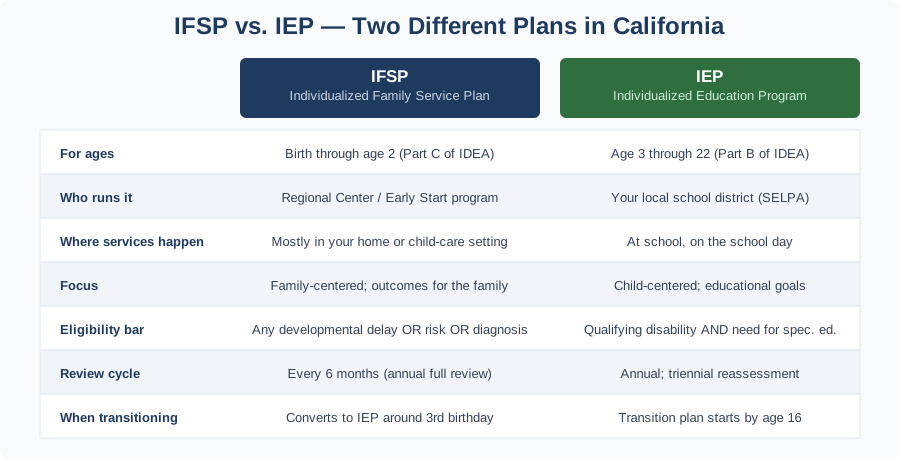
Side-by-Side Comparison: IFSP vs IEP
Seeing these two plans next to each other makes the differences clearer:
- Age range: IFSP covers birth to 3. IEP covers ages 3 to 22.
- Who manages it: IFSP is managed by Regional Center (Early Start). IEP is managed by your school district.
- Focus of the plan: IFSP is family-centered. IEP is child and education-centered.
- Where services happen: IFSP services are delivered in natural environments like home or daycare. IEP services happen at school.
- Review schedule: IFSP is reviewed every 6 months. IEP is reviewed annually.
- Full re-evaluation: IFSP requires annual evaluation. IEP requires re-evaluation every 3 years.
- Who pays: Both are free to families. Early Start covers IFSP services. The school district covers IEP services.
- Federal law: Both are protected under the Individuals with Disabilities Education Act (IDEA), but under different sections. IFSP falls under Part C. IEP falls under Part B.
The Transition from IFSP to IEP at Age 3
This is the part that catches many families off guard. When your child turns 3, they "age out" of Early Start and the IFSP process. If they still need services, they transition to the school district and the IEP process.
This transition can feel abrupt and scary. You have built relationships with your Early Start team. Your child receives therapy at home. Everything feels familiar. And then suddenly, at age 3, a completely different system takes over.
Here is what to expect during the transition:
- Planning starts early: Your Regional Center should begin transition planning at least 6 months before your child's third birthday. If they haven't brought it up by the time your child is 2 years and 6 months old, ask about it.
- A transition conference happens: Your Regional Center Service Coordinator will schedule a meeting with you and the school district. This is where information about your child is shared (with your permission) and next steps are discussed.
- The school district evaluates your child: The district conducts its own assessment to determine whether your child qualifies for special education services under an IEP. Having an IFSP does not guarantee IEP eligibility, though many children do qualify.
- An IEP meeting is held: If your child qualifies, the district holds an IEP meeting before your child's third birthday to develop the plan.
- Services may change: The types, frequency, and location of services may look different under an IEP. Therapy that happened at home may now happen at a preschool or school setting.
A few important things to remember during transition: You are a full member of the IEP team. You can bring someone with you for support, such as a friend, family member, or advocate. You can request specific services and goals. And if you disagree with the school district's decisions, you have rights.
Your Rights in Both Processes
Whether your child has an IFSP or an IEP, you have strong legal protections under the Individuals with Disabilities Education Act (IDEA). These rights include:
- The right to participate: You are a required member of the team that develops your child's plan. Meetings cannot happen without you unless you agree.
- The right to informed consent: Services cannot begin without your written permission. You can withdraw consent at any time.
- The right to access records: You can review all records related to your child's evaluation and services.
- The right to disagree: If you disagree with an evaluation, you can request an Independent Educational Evaluation (IEE) at public expense.
- The right to due process: If disputes cannot be resolved informally, you can file for mediation or a due process hearing.
- The right to prior written notice: The agency or school district must notify you in writing before making any changes to your child's plan or services.
California also provides additional protections through the Lanterman Act (for Regional Center services) and state education code (for school-based services). You have more power in these processes than you might realize.
What to Do If You Disagree
Disagreements happen. Maybe the school district says your child does not qualify for an IEP when you believe they should. Maybe the Regional Center offers fewer therapy hours than your child needs. Maybe the goals in the plan do not match your child's actual needs.
Here is what you can do:
- Start with a conversation. Talk to your Service Coordinator or the IEP team about your concerns. Many disagreements can be resolved through honest discussion.
- Put it in writing. Follow up verbal conversations with an email or letter that documents what was discussed and what you are requesting.
- Request an Independent Educational Evaluation. If you disagree with the school district's assessment, you can ask for an outside evaluation at no cost to you.
- Use mediation. Both the Regional Center and school district systems offer mediation, where a neutral third party helps you reach an agreement.
- File a complaint. You can file a compliance complaint with the California Department of Education (for IEP issues) or the Department of Developmental Services (for Regional Center issues).
- Request a due process hearing. This is a more formal legal proceeding where an administrative law judge makes a decision. Many families benefit from having an advocate or attorney for this step.
- Contact a parent advocacy organization. Groups like Disability Rights California and local Family Resource Centers can provide free guidance and support.
Tips for Your First IEP Meeting
Walking into your first IEP meeting can feel intimidating. You may be sitting across the table from five or six professionals who do this every day. But remember: you know your child better than anyone in that room.
- Bring someone with you. A partner, friend, family member, or parent advocate can provide emotional support and help you remember what was discussed.
- Write down your priorities before the meeting. What are the most important things you want for your child this year? Having this written down keeps you focused.
- Ask questions freely. If someone uses a term you do not understand, ask them to explain it. There are no silly questions.
- Take notes or ask to record the meeting. In California, you can record IEP meetings if you notify the team in advance.
- You do not have to sign the IEP at the meeting. You can take the document home, review it, and sign it later. Never feel pressured to sign on the spot.
- Focus on your child's strengths, not just challenges. A good IEP builds on what your child can do, not just what they struggle with.
- Request specific, measurable goals. Vague goals like "improve reading" are less helpful than specific ones like "read 50 sight words by the end of the school year."
Tips for Getting the Most from Your IFSP
The IFSP process tends to be more informal and family-friendly than the IEP process, but you can still advocate effectively:
- Be honest about your family's needs. The IFSP is designed to support the whole family. If you need parent training, respite referrals, or help connecting with other families, say so.
- Ask about all available services. Some families do not realize they can request services beyond the basics. Ask your Service Coordinator what your child might benefit from.
- Keep notes on your child's progress. Write down milestones, concerns, and changes you observe. This information is valuable at review meetings.
- Request changes between scheduled reviews. You do not have to wait for the 6-month review to request a change. If something is not working, speak up.
- Start thinking about the age-3 transition early. Ask your Service Coordinator about the transition process well before your child's third birthday so you are not caught off guard.
Can Your Child Have Both an IFSP and IEP?
In most cases, your child will have one plan or the other based on age. But there are situations where overlap can occur:
- During the transition at age 3: There may be a brief period where your child is transitioning from Early Start to the school district. Your Regional Center and school district should coordinate to prevent gaps in services.
- Regional Center services can continue alongside an IEP. Once your child turns 3 and has an IEP through the school district, they may still receive services through the Regional Center. The Regional Center provides services that are not the responsibility of the school district, such as respite care, behavioral services at home, or community-based support.
- Children with complex needs often benefit from both systems. The school district handles educational services. The Regional Center handles developmental and family support services. These are separate systems with separate funding, and your child can receive services from both.
The key is coordination. Make sure your Regional Center Service Coordinator and your school's IEP team are aware of each other and communicating about your child's needs.
You Are Your Child's Best Advocate
Whether your child needs an IFSP, an IEP, or both, the most important thing to know is this: you have a seat at the table. You are not a bystander in these processes. You are a full, equal member of the team making decisions about your child's future.
The system can feel overwhelming, especially when you are new to it. But every parent who has navigated an IFSP or IEP meeting started exactly where you are now. You learn as you go. You get stronger. And your child benefits from having a parent who shows up and asks questions.
You do not need a law degree or a background in special education. You just need to know your child, know your rights, and be willing to speak up. That is enough.