Regional Center Eligibility in California: Do You Qualify?
If you are trying to figure out whether your child qualifies for a California Regional Center, you are not alone in feeling confused. Regional Center eligibility is governed by the Lanterman Developmental Disabilities Services Act, a law first passed in 1969. The Act uses specific legal language that does not always match the way doctors, schools, or insurance companies describe disabilities. A child can have an IEP at school, a medical diagnosis, and clear support needs and still be told by a Regional Center that they are not eligible. It can be shocking, and it is worth understanding why.
This guide walks through the five eligibility categories, what counts as a "substantial disability," what kind of evidence Regional Centers look at, and what to do if your child is in the gray zone. It is written for parents, not for lawyers, but it uses the real terms you will hear during intake so that you can advocate clearly.
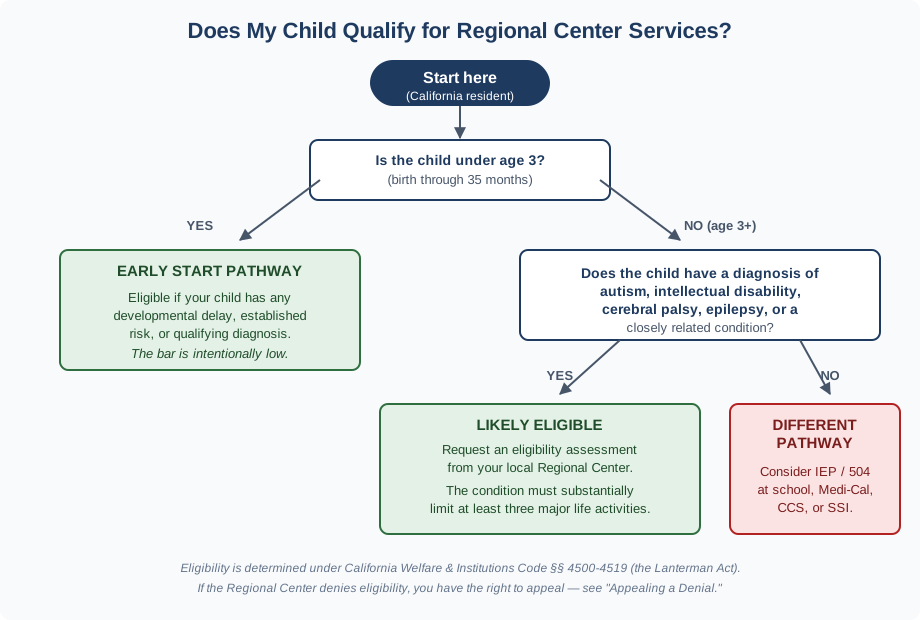
The Legal Starting Point: The Lanterman Act
Under Welfare and Institutions Code section 4512, a person qualifies for Regional Center services if they have a "developmental disability" that:
- Originates before age 18,
- Is expected to continue indefinitely, and
- Constitutes a substantial disability for that person.
In addition, the disability must fall into one of five specific categories. All three of the general conditions plus one category must be met. A child with a medical diagnosis alone is not automatically eligible. A child who has a label but no functional impact may also be turned away. This combination trips up many families.
The Five Eligibility Categories
California recognizes five qualifying conditions. Four of them are specific diagnoses and the fifth is a broader catch-all.
1. Intellectual Disability
Historically called "mental retardation" in the statute, this category is based on measured cognitive functioning and adaptive behavior. Typically the Regional Center looks for a full-scale IQ of approximately 70 or below paired with significant deficits in adaptive behavior (daily living skills). Scores in the 70 to 75 range are considered borderline and require careful adaptive testing such as the Vineland-3 or the ABAS-3.
Evidence usually includes a recent psychoeducational evaluation from the school, a private neuropsychological evaluation, or a Regional Center psychologist's assessment. Because IQ scores can fluctuate, you should bring every evaluation you have, not just the most recent one.
2. Autism
Autism is the fastest-growing category at Regional Centers. To qualify, your child needs a diagnosis of Autism Spectrum Disorder that meets DSM-5 criteria AND produces a substantial disability in three of seven major life activities (more on that below). A DSM-5 diagnosis alone, without functional impact, is not enough.
Strong evidence includes an ADOS-2 administered by a licensed clinician, a developmental pediatrician's report, school autism assessments, and detailed adaptive testing. If your child masks well in the clinic but struggles at home or school, collect video examples and teacher notes.
3. Cerebral Palsy
Cerebral palsy must be a medical diagnosis supported by a neurologist or developmental pediatrician. Imaging (MRI) is not strictly required but is common. The Regional Center will want to see both the diagnosis and evidence that the CP causes meaningful functional limits, for instance in mobility, self-care, or communication.
4. Epilepsy
This is the least common path to Regional Center eligibility. The child must have epilepsy as a primary diagnosis, not simply febrile seizures or an isolated episode, and the seizure disorder must cause a substantial disability. Most children with well-controlled epilepsy and no other disability do not qualify. Children with epilepsy plus cognitive delays often qualify under this category or category 5.
5. The "5th Category": Conditions Closely Related to Intellectual Disability
This is the most misunderstood category. It is for people who do not meet the strict IQ cutoff for intellectual disability but have a condition that requires treatment similar to what is required for someone with an intellectual disability. The Regional Center will look for significant cognitive impairment, adaptive deficits, and evidence that the condition originated before age 18.
Children with severe learning disabilities, significant developmental delays, genetic syndromes without the classic diagnostic label, or traumatic brain injury before 18 may fit here. This is not a "catch-all" for children with learning challenges alone, though. The Regional Center applies this category narrowly, and it is the most common source of denials.
What "Substantial Disability" Actually Means
Under Title 17 of the California Code of Regulations, a condition causes a "substantial disability" when it produces significant functional limitations in three or more of these seven major life activities:
- Self-care
- Receptive and expressive language
- Learning
- Mobility
- Self-direction
- Capacity for independent living
- Economic self-sufficiency (relevant for older teens and adults)
For young children, economic self-sufficiency is evaluated differently because children are not expected to work. For toddlers and preschoolers, the Regional Center often relies on comparisons to same-age peers in self-care, language, learning, and self-direction.
"Significant" does not mean "noticeable" or "slightly behind." It means the child cannot perform the activity in a way expected for their age and needs substantial help. Bring concrete examples. Instead of saying "she does not dress herself well," say "at age 6, she cannot button her own pants, manage fasteners, or put on shoes without step-by-step prompting, and it takes 40 minutes each morning."
What Evidence You Need
There is no single required document, but strong intake packages usually include:
- A current psychoeducational or neuropsychological evaluation (within the last 1 to 3 years)
- A medical diagnosis from a pediatrician, neurologist, or developmental pediatrician when the category requires it
- The most recent IEP or IFSP if one exists
- Standardized adaptive behavior testing (Vineland-3, ABAS-3)
- Speech, OT, and PT evaluations showing functional limitations
- A written parent statement describing daily life
- School progress reports and teacher letters
- For infants and toddlers, the Early Start assessment
You can also request that the Regional Center conduct their own psychological and medical evaluations at no cost to you. This is a right, not a favor.
How the Evaluation Process Works
After you submit an intake request, the Regional Center generally has 120 days to make an eligibility determination. That shortens to 60 days when a delay would put the child's health or safety at risk, delay their development, or risk placement in a more restrictive setting. For children under age 3, Early Start has its own faster timeline of 45 days from referral to complete assessment and develop the service plan. Most centers follow this sequence:
- Intake meeting. You meet an intake coordinator who collects records and asks questions about development, birth history, and family history.
- Record review. A multi-disciplinary team reviews the documents. If records are enough to decide, they may skip further testing.
- Additional assessments. If more data is needed, the Regional Center schedules psychological, medical, or other evaluations.
- Eligibility team meeting. A panel including a psychologist and physician reviews all information and votes on eligibility.
- Notice of Action. You receive a written decision. If eligible, you move to IPP. If not, the letter explains the reason and your appeal rights.
If you have not heard back within the legal timeline, send a written request for a status update and copy the Regional Center's manager of intake. Delays happen, but they are not supposed to.
Common Denial Reasons
Most denials fall into a few predictable patterns:
- "Solely psychiatric" findings. The Lanterman Act specifically excludes conditions that are solely psychiatric, solely learning disabilities, or solely physical in nature without cognitive involvement. A child with ADHD and anxiety but no cognitive or adaptive impairment will usually be denied.
- Borderline IQ without adaptive data. A child with an IQ of 72 and no adaptive testing often gets denied. Adding a Vineland-3 with low adaptive scores can change the outcome.
- Autism diagnosis without functional impact documented. Some children with ASD perform well in structured settings. Without adaptive scores and parent interview data, the Regional Center may say the disability is not substantial.
- Category 5 used too loosely. A child with specific learning disabilities or language delays only will usually not qualify under the 5th category.
- Records are outdated. Evaluations older than 3 years are often set aside. Get current testing before intake.
Borderline Cases: What to Do
If you suspect your child is on the line, do three things before intake is finalized.
First, get adaptive behavior testing. Many evaluations report IQ and academic scores but never measure daily living skills. A Vineland-3 or ABAS-3 administered by a school psychologist or private clinician can make or break a case.
Second, document real-life functioning. Keep a one-week log of what your child can and cannot do independently. Include morning routine times, communication breakdowns, and safety risks. Submit it with intake.
Third, request a Regional Center psychological evaluation. Some families assume they need to provide everything. The Regional Center's own psychologists are familiar with Lanterman standards and sometimes catch things outside evaluators miss.
If the decision still comes back as a denial, you have the right to appeal. Do not accept "not eligible" as the final word, especially for a 5th category case. See our guide on appealing a Regional Center denial.
Early Start: A Different Standard Before Age 3
Children under age 3 follow a separate track called Early Start. The qualifying standard is more flexible: a child can qualify with a 33 percent delay in one domain or 25 percent delays in two domains, or with a qualifying medical condition. Early Start eligibility does not automatically transfer to Lanterman eligibility at age 3. Around a child's third birthday, the Regional Center will reassess under the stricter adult standard, and many families get a surprise denial at that point. Plan for this transition with your Service Coordinator.
Common Conditions and How They Usually Land
Every case is individual, but these patterns show up often:
- Down syndrome: Almost always eligible under intellectual disability. Bring the genetic testing.
- Autism with cognitive impairment: Usually eligible, provided ADOS-2 and adaptive scores are documented.
- Autism with average or above-average IQ: Eligibility depends heavily on adaptive scores and real-life functioning. Gather strong evidence.
- ADHD only: Typically not eligible.
- Specific learning disability only: Not eligible.
- Cerebral palsy (any severity): Eligible if substantial disability is documented.
- Rare genetic syndromes (e.g., Prader-Willi, Fragile X, Angelman): Usually eligible under intellectual disability or category 5; bring genetic records.
- Fetal alcohol spectrum disorder: Often eligible under category 5 if cognitive and adaptive impact is shown.
- Traumatic brain injury before age 18: May qualify under category 5.
What Happens After Eligibility
Being found eligible is the beginning, not the end. The next step is an IPP meeting (or IFSP if your child is under 3) where you and the Regional Center plan services. You will be assigned a Service Coordinator. Services can include respite, behavioral therapy, diaper supplies, nursing, day programs, supported living, or the Self-Determination Program. None of these are automatic; they are negotiated case by case.
If you are just starting, you do not need to know all of this yet. Focus first on getting eligibility correctly established, then expand from there.