How to Apply for a California HCBS Waiver: Step-by-Step Guide
If someone has told you to apply for an "HCBS Waiver" for your child and you left the conversation more confused than when you started, you are in good company. California runs several Home and Community-Based Services (HCBS) waivers, each with a different gatekeeper and a different purpose. The good news is that one of them, the DDS Waiver, quietly changes everything for most families of children with developmental disabilities. It can cover therapies, respite, nursing, home modifications, and it can put your child on Medi-Cal even if your family income is too high to qualify otherwise.
This guide walks you through what HCBS waivers are, which one your child might need, and exactly how to apply. We focus on the DDS Waiver because it serves the largest group of California children with disabilities, but we also explain the HCBA, ABI, AIDS, and MSSP waivers so you know whether one of those fits your situation better.
What an HCBS Waiver Actually Does
HCBS stands for Home and Community-Based Services. A waiver is a special agreement between California and the federal Medicaid program that lets the state "waive" normal Medi-Cal rules so people who would otherwise need to live in an institution can receive care at home instead.
For your family, this matters in two big ways:
- It unlocks services that regular Medi-Cal does not cover, like respite, behavioral intervention, environmental accessibility adaptations, and specialized nursing.
- It changes how Medi-Cal looks at income. When a child is enrolled on an HCBS waiver, the state uses "institutional deeming," which means only the child's income counts, not yours. Families earning well into six figures can have their child covered by full-scope Medi-Cal through this rule.
The Five Waivers California Families Should Know
There are more waivers on paper, but these are the ones that serve children and young adults with disabilities in California:
1. DDS HCBS Waiver
Run by the Department of Developmental Services and administered through your local Regional Center. This is by far the most common waiver for California kids with intellectual disabilities, autism, cerebral palsy, and epilepsy. It is the focus of this guide.
2. HCBA Waiver (Home and Community-Based Alternatives)
Run by the Department of Health Care Services. For people of any age who would otherwise need nursing facility care. Often used by medically fragile children who are not Regional Center clients or who need more medical support than the DDS Waiver covers. Capped statewide, so there can be waiting lists.
3. ABI Waiver (Acquired Brain Injury)
For adults 18 and older with an acquired brain injury. Not available for children under 18, but worth knowing if your teen is approaching adulthood and has a brain injury.
4. AIDS Waiver
For individuals with a diagnosis of AIDS or symptomatic HIV. Less common in pediatric cases but still an option in some counties.
5. MSSP (Multipurpose Senior Services Program)
For frail adults 65 and older on Medi-Cal. Relevant mostly for grandparent caregivers or aging family members, not for children.
Throughout this article, when we say "waiver" without a qualifier, we are talking about the DDS Waiver.
DDS Waiver Eligibility: The Three Gates
To get on the DDS Waiver, your child has to pass through three doors:
Gate 1: Regional Center Eligibility
Your child must first be a Regional Center client under California's Lanterman Act. That means a qualifying developmental disability (intellectual disability, autism, cerebral palsy, epilepsy, or a condition closely related to intellectual disability) that originated before age 18 and is expected to continue indefinitely. If your child is under three, they may qualify through Early Start using different criteria.
Gate 2: Level of Care (LOC) Determination
Your child must meet a "level of care" that would otherwise require placement in an Intermediate Care Facility for people with developmental disabilities. In plain English, without the services the waiver pays for, your child would need institutional care. Your Regional Center Service Coordinator completes this assessment using a Client Development Evaluation Report (CDER) and a DS 1890 form.
Gate 3: Medi-Cal Enrollment
Your child must be eligible for full-scope Medi-Cal. If they are not already enrolled, this is where institutional deeming comes in. The Regional Center refers your child to your county Medi-Cal office using specific codes, and the county enrolls the child counting only the child's own income and resources.
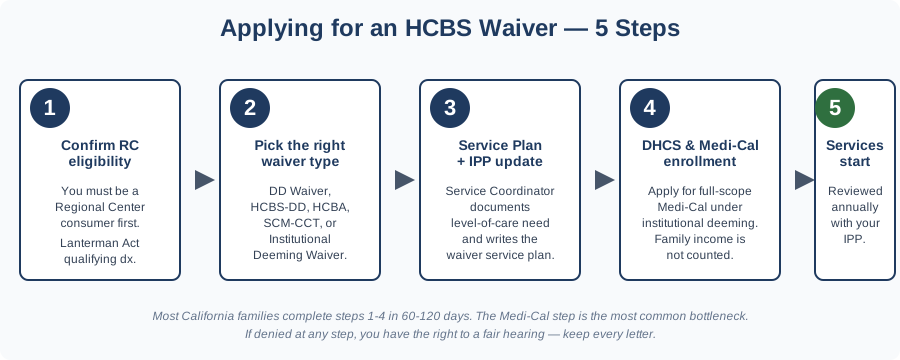
Step-by-Step: Applying for the DDS Waiver
Step 1: Get a Regional Center Intake Appointment
If your child is not already a Regional Center client, call your local center and ask for an intake. You do not need a doctor's referral. Intake takes 60 to 120 days for kids over three, and Early Start intake for babies and toddlers is faster, typically within 45 days of referral.
Step 2: Ask Specifically About HCBS Waiver Enrollment
Here is the part families miss. Becoming a Regional Center client does not automatically put your child on the HCBS Waiver. You have to ask. Tell your Service Coordinator: "I want to enroll my child in the DDS HCBS Waiver." Put it in writing by email. Your Service Coordinator will then start the LOC assessment and the Medi-Cal paperwork.
Step 3: Complete the LOC Assessment
Your Service Coordinator will schedule a CDER update and complete the DS 1890 form, which documents why your child needs an institutional level of care. You do not fill out these forms, but you should share everything that supports the case: medical diagnoses, behavioral reports, school assessments, and real-life examples of the supervision and support your child needs. The more concrete, the better.
Step 4: Gather Medi-Cal Documents
Even when institutional deeming applies, the county needs paperwork. Gather:
- Your child's birth certificate and Social Security card
- Your child's proof of California residency
- Your child's immigration status documents, if applicable
- Any proof of your child's own income or assets (usually none, which is the point)
- Proof of the child's Regional Center enrollment
You do not need to submit your own tax returns or paystubs for the child's waiver Medi-Cal application because parental income is not counted.
Step 5: The Regional Center Sends the Package to the County
Your Service Coordinator submits the completed LOC paperwork along with a DHCS 7098 B form to your county Medi-Cal office. The county processes the application using waiver-specific aid codes. If your child was already on Medi-Cal through another pathway, the aid code simply changes.
Step 6: Wait for the Notice of Action
You will get a Notice of Action (NOA) from the county confirming your child's waiver Medi-Cal enrollment. Keep this letter. It is proof your child is on the waiver.
Step 7: Build the Individual Program Plan
With waiver enrollment secured, your Service Coordinator works with you on an Individual Program Plan (IPP) that includes the specific waiver services your child will receive.
Waiting Lists: The Truth Families Deserve
California's DDS Waiver has historically not had a waiting list. The state has funding slots sized to demand, and eligible children generally move through the process without a formal queue. That does not mean it is fast. Bottlenecks happen at Regional Center intake, at LOC assessment, and at county Medi-Cal enrollment. Expect 90 to 180 days from start to waiver enrollment in most cases, longer if documentation is incomplete.
The HCBA Waiver is different. It is capped statewide at a specific number of slots, and waiting lists can stretch for months or longer depending on the year. If your child needs HCBA, get on the list the day you decide to apply.
Other Waivers at a Glance
How to Apply for the HCBA Waiver
Call the HCBA Waiver intake number or contact a local HCBA Waiver Agency. The agency's registered nurse conducts a home assessment and submits paperwork to DHCS. The process typically takes four to eight weeks after an open slot is available.
How to Apply for the ABI Waiver
Contact a Care Management Agency certified by DHCS for the ABI Waiver. The person must be 18 or older with documented acquired brain injury.
How to Apply for the AIDS Waiver
Contact the AIDS Medi-Cal Waiver Program office serving your county. A case manager completes the intake and coordinates services with your medical team.
How to Apply for MSSP
Contact your local MSSP site (listed by county on the California Department of Aging website). MSSP is for Medi-Cal-eligible adults 65 and older.
What the DDS Waiver Pays For
Once your child is enrolled, the DDS Waiver can pay for services like:
- Respite care in and out of home
- Behavioral intervention services, including applied behavior analysis outside of what regular Medi-Cal covers
- Supported living services for adults and older teens
- Environmental accessibility adaptations like ramps, bathroom modifications, and sensory rooms
- Specialized medical equipment and supplies
- Nursing services in the home
- Transportation to community activities
- Day services and community integration
Services are funded through the Regional Center's purchase-of-service budget and authorized through the IPP.
Common Application Pitfalls
Pitfall 1: Assuming Regional Center Intake Enrolls You in the Waiver
It does not. Ask explicitly for waiver enrollment.
Pitfall 2: Incomplete Medical Documentation
The LOC assessment relies on evidence. A one-sentence diagnosis letter from a pediatrician is not enough. Bring developmental assessments, behavior plans, IEP evaluations, and specialist reports.
Pitfall 3: Not Reporting All Functional Limitations
Parents often describe their child's best moments. For LOC, describe the hardest moments too. Elopement, self-injury, inability to follow safety commands, need for 24-hour supervision: all of it matters.
Pitfall 4: Missing the Deeming Code
If the county enrolls your child under regular family Medi-Cal rules, they will count your income and may deny the case. Make sure the paperwork specifies the waiver aid code and institutional deeming.
If You Are Denied
Two main denial points exist: Regional Center eligibility and waiver LOC.
If Regional Center eligibility is denied, you have 60 days from the date on the Notice of Action to request a fair hearing under the Lanterman Act. (A separate 30-day rule only applies when you want existing services to continue unchanged during an appeal, which does not apply to an initial eligibility denial.) You can also request an informal meeting or mediation first.
If LOC or Medi-Cal waiver enrollment is denied, you have 90 days to file a state hearing request with the California Department of Social Services. Keep the Notice of Action. The appeal is free, you can bring an advocate, and parents win these hearings all the time when they bring documentation.
Once Your Child Is Enrolled
Waiver status must be reviewed annually. Your Service Coordinator should automatically submit the updated paperwork, but it is smart to put a reminder on your own calendar. If your Medi-Cal annual renewal packet arrives, do not ignore it, even with waiver enrollment. Lost Medi-Cal means lost waiver services.
The DDS HCBS Waiver is one of the most powerful tools in California's disability system. It is also one of the most under-explained. Once you know the door exists, opening it is a matter of patience and paperwork.